Holiday Season Marketing Ideas for Restaurants and Takeaways
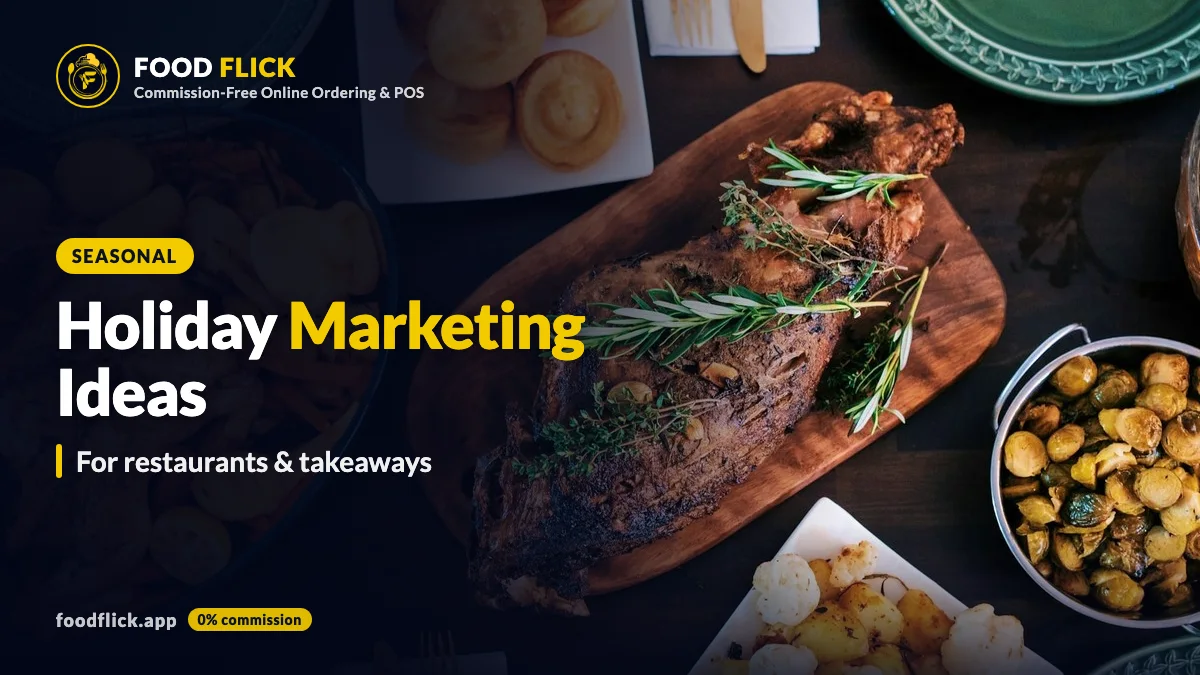
December can be the best month of the year for a restaurant or takeaway, and the most chaotic. Guests book parties, families want a table or a feast at home, and everyone checks whether you are open on the days that matter. This guide gives you holiday marketing ideas for restaurants that are cheap to run, easy for staff to explain and built around Christmas and New Year 2026.
It is written for owners of independent restaurants, takeaways and small groups who take orders directly. By the end you will have 12 ideas, a week-by-week timeline from late November to January, and a short list of mistakes that cost holiday orders every year.
What dates should restaurants plan around in 2026?
Plan around the days when customers will be searching for who is open. In 2026, Christmas Day is Friday 25 December and New Year's Day is Friday 1 January 2027. In England and Wales, the UK government lists Monday 28 December as the substitute Boxing Day holiday, so the long weekend runs from 25 to 28 December.
New Year's Eve falls on Thursday 31 December. If you are in another country, check your own public holiday calendar and any local festivals, such as Hanukkah or Kwanzaa, that matter to your neighborhood and your regulars.
What are the best holiday marketing ideas for restaurants?
These 12 ideas are ordered from "do this first" to "do this if you have time". You do not need all of them. Pick four or five that suit your kitchen and do them well.
1. Publish your holiday hours early
Guests will check whether you are open before they decide where to eat. Put your hours on your website, your Google profile, your social bios and your door in the first week of December. Google says it is a good idea to confirm your hours for official holidays, even when they match your normal hours, because it shows customers the listing is accurate.
2. Set last order dates
Tell customers the last day for pre-orders and the last delivery slot, for example "Christmas Eve orders close at 2 p.m. on 22 December." Cut-offs protect your kitchen and create urgency without any discount.
3. Sell pre-order party platters and feasts
Platters, sharing boxes and "feed the family" bundles raise order value because one order replaces several. A 30-seat Indian restaurant could offer a Christmas Eve feast for four at a fixed price, with collection slots every 15 minutes. Build it as a single menu item with sizes and options so customers can order in under a minute.
4. Launch a limited festive menu
Three starters, three mains and two desserts is plenty. A short menu is faster to cook, easier to cost and gives your social posts a reason to exist. Mark the end date clearly and remove it when the season ends.
5. Offer set menus for office parties
Companies and groups want one price per head, a deposit rule and a simple way to pre-order. Publish the set menu with a minimum group size and a cut-off date for final numbers. Post it to your website and send it to local offices and community groups in person.
6. Add a "bring them back in January" offer
Quiet weeks follow the festive rush. Hand out a card or add a note to each bag: "Order again between 4 and 31 January and get 10% off." This turns busy-month first-time customers into repeat ones. A card with your ordering link or a QR code is enough.
7. Sell gift vouchers the old-fashioned way
If your system does not offer digital gift cards, a printed voucher card or a handwritten voucher at the till still works, and it brings guests in after the holidays. Track what you sell and honor each voucher once. Check your local rules on gift card expiry before you set an end date.
8. Use your Google profile like a shopfront
Google lets you add Offers and Events posts that show on Search and Maps. An offer needs a title, dates and times, and Google adds a "View Offer" button. Post your festive menu and your New Year's Eve event, add your holiday hours as special hours, and check the photos show your food, not last year's decorations.
9. Photograph the festive menu once, well
You do not need a studio. Natural light near a window, a clean plate and a plain background are enough. Use the same photos on your online menu, your Google profile, Instagram and the poster in your window.
10. Partner with a local business
A nearby gym, salon or office can share your offer with its customers, and you can do the same for theirs. Keep it simple: a flyer or a shared post, no money changing hands.
11. Push direct ordering at every touchpoint
Busy weeks bring in guests who have not ordered from you before, so every bag, box and receipt should carry your own ordering link. Add a QR code on your door, window and takeaway bags. If you want to see the savings, run your numbers in the commission calculator.
12. Thank your regulars
Post a short thank-you on your social pages and in-store on your last day before closing. It costs nothing and people share it.
What does a holiday marketing plan look like week by week?
Use this timeline for 2026. Shift the dates if your holiday falls at a different time.
When | What to do |
|---|---|
Week of 23 Nov | Decide your festive menu, party platters and cut-off dates. Photograph the food. |
Week of 30 Nov | Publish the menu and offers on your website and Google profile. Start in-store signage. |
Week of 7 Dec | Add special hours for 24 to 28 December and 31 December to 1 January. Remind customers of pre-order cut-offs. |
Week of 14 Dec | Push last chances for office parties and platters. Brief staff on the offers. |
21 to 23 Dec | Close pre-orders on the date you announced. Confirm prep, packaging and driver plans. |
24 to 28 Dec | Run the service. Hand out January return cards. |
29 Dec to 1 Jan | New Year's Eve and Day service, then thank-you posts. |
January | Track return offers, review what sold and plan next year's menu. |
How do you know if holiday promotions are worth it?
Work out the profit, not just the sales. Say a party platter sells for $60 and costs $24 in food and $6 in packaging. You keep $30 before labor and card fees. If the platter replaces a table of four ordering separately, it still helps because you serve the group faster and avoid a long wait.
Now test a discount. A 10% January offer on a $30 order costs $3. If your normal food cost is 30% ($9), you still keep $18 before labor and fees. Compare that cost to what you would pay a delivery app in commission to find the same customer. Our direct ordering guide explains why a repeat order that comes straight to you is worth more.
Track three numbers for the season: the number of pre-orders, the average order value and how many January return cards come back. If you cannot measure it, do not repeat it.
Common mistakes to avoid
Posting holiday hours too late. Customers decide where to eat days before. Publish hours by the first week of December.
Leaving "temporarily closed" on. Google says special hours suit changes of up to 6 days in a row, and that closures of 7 or more days should use the temporary closure setting instead.
Offering too many specials. A long festive menu slows the kitchen. Keep it short.
No cut-off date. Without one, you will accept orders you cannot cook.
Discounts without a limit. Set an end date and a per-order cap so offers cannot run away.
Forgetting allergens. Festive dishes often contain nuts, gluten or dairy. Label them clearly on your menu.
Not telling staff. If the till team cannot explain the offer, customers will not use it.
How FoodFlick helps
FoodFlick gives your restaurant its own branded ordering website on your own domain, so festive menus, pre-orders and delivery or pickup orders go straight to you with 0% commission. You can set business hours, discounts, pricing rules and delivery zones, and orders reach your kitchen in real time with thermal printing. The FoodFlick team sets up your menu, branding and domain for you, and customer payments go directly to your payment provider. Card processing fees from the provider still apply. See how it works with online ordering, or read why commission-free ordering matters when volume peaks.
Sources
GOV.UK: UK bank holidays, checked November 2026
Google Business Profile Help: How to set special hours, checked November 2026
Google Business Profile Help: Add posts to your Business Profile, checked November 2026
Frequently asked questions
When should restaurants start promoting Christmas and New Year?
Start in the last week of November. Company parties, family bookings and pre-orders are planned weeks ahead, so publish your festive menu, cut-off dates and holiday hours by early December and keep reminding customers until your last order date.
What are the best holiday promotions for a takeaway?
Pre-order party platters, family bundles, a limited festive menu and a January return offer work well because they raise order value and bring customers back. Keep offers simple, with a clear end date, so staff can explain them in one sentence.
How do I update my holiday opening hours on Google?
Open your Business Profile, choose Edit profile, then Hours, and add Special hours for each date. Google says to confirm hours even for official holidays that match your normal schedule, and each set of special hours can cover up to 24 hours.
Should I take pre-orders for Christmas Day and New Year's Eve?
Yes, if your kitchen can handle it. Pre-orders with set collection or delivery slots and a cut-off date let you plan staff and stock, and they smooth the rush. Cap the number of orders per time slot so quality holds up on the busiest days.